Author Archives: portsarecalling

Stuck In The Middle With You, Ernest Hemingway and His First Wife.

Hammock-Beach-ReadingIt’s official, as of today, summer’s here! Thank the Lord. Spring is about glorious awakenings, autumn treats us to some of the most brilliant colors, and winter may get a bum rap but I love it because there’s nothing like waking up to a fresh carpet of snow, unless you’ve got to dig your car out from six feet of it.  But there’s just something about summer.   It somehow gives us a free pass. It allows us to shed the stress and slog of the daily grind. It’s kind of unspoken but it seems to allow for a universal laziness of sorts. Even retired friends and relatives whoop it up more, which is kind of strange since they don’t work. The Europeans have it right with their extended weeks of summer vacation. It’s probably one of the few areas where the U.S. missed the boat. But hey, you get what you get, so make the most of it, and for those travel ambassadors out there—don’t forget to write about it.

Woman_reading_at_the_beachOne of the pleasures of planning a summer holiday is figuring out what books to take, especially if you’re flying. The only thing that makes a plane ride bearable if you’re stuck in the middle seat of a coach flight is a good book. You’re partly folded up as it is, so why not go all the way and dive into a classic, or mystery, or someone else’s life? There’s nothing like tucking into a real page-turner. If you’ve already hit the road, chances are you’re toting a few books or a Kindle or some other digital device to get your reading kicks. Whether they’re of the rip and read variety or epic tomes, when you’re in the thick of a good tale, nothing—not even sleep—can get you to put a good book down. Pay no mind to anyone who may think you’re just lying around. Reading is an activity and a good one to have. Plus, it makes you a better writer. Whatever your plans are—vacation or staycation—books fuel that sense of escapism. Here are a few recommendations, fiction and non-fiction, collected from reading junkies, to pack for any summer getaway. They are in no particular order.

The Good Nurse: A True Story of Medicine, Madness, and Murder by Charles Graeber. Terrifying, unsettling, suspenseful, thoughtful—this is true crime at its finest. Graeber’s investigative journalism into the nine-year killing spree by the nurse, Charles Cullen, is up close and personal but it’s the cover-up by the hospital administrators that’ll really freak you out. I had the good luck to catch Graeber’s appearance at a local bookstore and the hairs went up on the back of my neck just listening to the excerpts.

My friend Mary has a thing for the British spy genre so if you’re up for a bit of espionage, betrayal, suspense—and who isn’t when it’s not your life—then you may want to venture down this road. Restless by William Boyd is a historical novel set during WWII. Its heroine is a 28-year-old Russian émigré living in Paris who ends up in the British Secret Service and learns to become the perfect spy. If you’re in the mood for more passion and deceit, she also recommends Sweet Tooth by Ian McEwan. It’s an intriguing tale about an Oxford-educated middle-class girl in 1970s England whose beauty and intelligence leads her into a double life as a drab civil servant and as a secret agent infiltrating the current literary intelligentsia. Ultimately, it’s about the process of writing a novel seen through the eyes of a duped writer who falls prey to what turns out to be a disastrous government scheme to manipulate Cold War sympathies through the literary world.

If you’re into weird and supernatural stories, lose yourself in Vampires In The Lemon Grove by Karen Russell. Eight short stories make up the collection within these magical tales where anything can happen, from captive girls transforming into silkworms (creepy), to a president reincarnated as a horse. Russell’s been noted one of the best writers under 40 and she also wrote the best seller Swamplandia.

Wild: From Lost to Found on the Pacific Crest Trail by Cheryl Strayed. Strayed’s name couldn’t be more perfect. In the wake of loss after her mother’s death, and then her marriage, Strayed goes it alone with no experience, to hike the Pacific Crest Trail. She’s a train wreck and you’ll journey with her through the solitude, the terrain, and meeting and experiencing the other beings along the way that lead her to knowledge and healing. This book shows us why travel is good for the soul.

Visit the ex-pat life during jazz-age Paris with Ernest Hemingway in this novel told from the perspective of his first wife, Hadley Richardson. It may sound like paradise but the man was no picnic. The Paris Wife by Paula McLain takes you into their world and shows us heaven and hell all wrapped up in one.

Italian Folktales by Italo Calvino. This collection of magical, scary, and wacky tales is good for all ages and it made the New York Times Best Book of the Century List. One note, the Kindle version doesn’t live up to what’s in the paperback.

I wouldn’t want to relive my teenage years but revisiting the adolescent angst-ridden days of Mary Karr’s youth growing up in East Texas in her memoir Cherry is a wild ride. Karr’s writing is riveting, raw and addictive. There’s not a wasted word, and men and women will glimpse themselves in her writing. After her first kiss with a local boy she nails it when she wonders, “How can you know such a thing about a person and not lean into it?” Insecurity never felt so good.

The Magician’s Nephew by C.S. Lewis. The back-story to The Lion, The Witch and The Wardrobe. Whether you’re 15 or 50, it’s C.S Lewis and it’s pure magic, and the perfect summer story to take you far, far away.

Transatlantic by Colum McCann. This book is on the reading list of pretty much every one I hit up for recommendations. It’s a multi-layered tribute story in which McCann explores the ties between the U.S. and his Irish homeland. This novel leapfrogs continents, centuries, and introduces a cast of real and fictional characters.

Joyland by Stephen King. All I know is that it’s a paranormal mystery tale and can only be purchased in hard copy or audio download, but it’s summer and it’s Stephen King so why not spend it with a master storyteller.

As much as I love summer, I wilt in the heat. A boiling hot New York day is not my idea of a good time, which makes Endurance: Shackelton’s Incredible Voyage by Alfred Lansing, one of my all time, favorite summer reads. This story is the definitive account of Ernest Shackelton’s fateful trip to cross the Antarctic overland. It didn’t turn out too good when his ship, the Endurance, became trapped “like an almond in a chocolate bar” in the ice and eventually crushed. Shackelton and his crew survived on drifting ice packs in one of the most inhospitable areas on the planet.  I’ve read it a few times.

There are loads of best of summer reading lists out there. What’s in your hot little hands these days?

Field Trip.

“What is that feeling when you’re driving away from people and they recede on the plain till you see their specks dispersing? – it’s the too-huge world vaulting us, and it’s good-bye.
But we lean forward to the next crazy venture beneath the skies.”
Jack Kerouac, On the Road

Milky Way over Evans

Milky Way over Evans (Photo credit: casey mac)

Stars.  What is it about looking up into an ink black night studded with stars that makes you feel at one with the universe?  Living in New York City doesn’t give us too much opportunity to really see stars.  They’re too dimmed by the massive amount of light set to a permanent on position.  But now I was in Colorado, my aunt had died, and I was on a back porch in a small town just outside of Denver, gazing up at the heavens and the wonder of it all.  In the distance, a coyote yipped.

It’s a funny thing to travel to a place and have no agenda.  No travel agenda, that is.  There’d be no activities, no wandering.  I was there to be with my cousins, to celebrate their mother’s life. On the porch the next morning, I wanted to jump into the wide expanse of big blue sky, not a cloud in it.  Birdsong rang through the air, settled around us and came in spells from the reserve the house borders.  This breadth of land is a plain field of tall, pale grass but there’s nothing plain about it.  To the west, the Rocky Mountains were as majestic as ever.  Their snow-capped peaks shone bright in the sunlight, like massive Hershey Kisses in their foil.   This mountain range humbled me.  I’m not the first person to feel their awe.  Nature does this to us in thousands of ways, large and small.  It was going to be a heavy trip for sure, but there was something about the sweet scent of grass, and the bigness of it all that I disappeared into. The doing of…nothing, the just being, the simplicity of it all put life and death into perspective.  Made it easy to give comfort.  These mountains have been here long before us and will be here long after the last of my family has turned to dust.

Snow-Capped Colorado Rocky Mountains

Snow-Capped Colorado Rocky Mountains (Photo credit: Rockin Robin)

My aunt was born a Kansas girl but eventually set her roots and boots in Colorado.  This side of my family, and the rest of my cousins and older siblings who came to pay their respects, hail from Topeka, the Land of Oz, and when we gather it’s like a trip back in time.  We don’t see each other often but when we do there seems to come alive some semblance of a childhood preserved by the memories we share of that place and the grandparents we lost long ago.   My brood of cousins, and siblings, has the greater history of the Midwest.  They are the Kansas of my childhood visits.  They are the brilliant fields of sunflowers and tall stalks of sweet corn, and the clink-clank of the Santa Fe Railroad that chugged and whistled behind my grandparents’ faded out white house.  They are the scent of the penny candy shop that no longer exists, a barefoot walk on a hot summer’s day to the Dairy Queen, drive-in movies, and lakeside camping.   They are mid-Western mannered, speak in “yes sirs and no ma’am’s,” and have a gentility those of us who grew up on the East Coast lack.   “It smells like Topeka in here,”   I said when I entered my cousin’s Mel’s home.   “I couldn’t ask for a better compliment,” she said.  In some ways, I guess I made two trips.

Sunflowers at Sunset

Sunflowers at Sunset (Photo credit: Stuck in Customs)

Flying back, the plane had a fiery sunset on its tail all the way home and I gazed out the window until I could no longer see the fields and the Rockies.   The rest of my cousins were also flying or driving back to their homes.  We all had living to get back to but I hoped my aunt was somewhere in the springtime of her youth, running wild through a field of sunflowers.

Trick Of The Eye.

English: Aerial view of Everest. Picture taken...

This past week, on May 29, marked the 60th anniversary of the first successful British expedition to Mount Everest.  These days we’re able to travel easily to pretty much any place on the planet, yet Everest still represents a challenge to anyone who attempts to climb it.   That’s a good thing.

We all have our Everest.  It might be something we’ve already accomplished or something we’re still aiming toward.   We may keep it private or choose to publicize it.  Whether we’re taking baby steps or moving fast, the point is we’re moving.  That’s also a good thing.  Writing is like this, and for travel agents and advisors with any interest in using this medium to create value for themselves, and their customers, taking advantage of the opportunities that expose them to travel experiences is key.  Sometimes you need to have “soft eyes” to see the opportunities.

What are soft eyes?  If you’ve ever been on safari, you know what they are.  If not, well…it’s
kind of like separating the forest from the trees, literally.  Everything looks like the same color out there on the savannah but the place is teeming with animals, large and small, yet many times you can’t see them.  So you try really hard to find them, and you can’t…but they’re there.  Opportunities that connect you to travel can kind of be like that and I recently found one.  It’s not always possible to get away, so I’ve come to have soft eyes about where I get my travel kicks.

Stray cats...how many can you spot? (Photo by author.)

Stray cats…how many can you spot? (Photo by author.)

The Times, Mount Everest Expedition report, May 1953.  (Photo credit:  The Times)

The Times, Mount Everest Expedition report, May 1953. (Photo credit: The Times)

Ever read Pax Britannica?  If not—no worries.  I haven’t read it either, but I do know who Jan Morris is—she’s the author of that book.  She also accompanied the first British summit to Mount Everest, except at that time she was a man.  In 1953 Morris was a journalist for The Times, and was assigned as an embedded special correspondent with Sir Edmund Hillary and Nepalese Sherpa Tenzing Norgay on their trek to Everest.  The rest—as we know—is history, and that summit also made Morris famous.  Morris had never climbed a mountain before that epic journey but was a very ambitious person and saw the opportunity for what it was.  Years later Morris became a well-known, and well-respected, travel writer.  In April, I worked an event at the Times Center and noticed that she would be in New York City for a Times Talk interview as part of GeoEx’s far-flung journeys.  I immediately booked a ticket.

A few weeks later, sitting in the theatre, listening to Jan Morris’ English accent, it almost felt like we were at home with her in Wales as she retold her travel tales.  The only thing missing was the pot of tea.  The questions focused on Everest but eventually settled on traveling and writing.  It was good to hear that she writes for her own pleasure.  So many times you hear of writers who slog it out, but writing—especially when it flows—is extremely pleasurable.  Sure, as a journalist, she may have had a head start but she still had to experience a sense of place to write about the destinations she visited.  And so it goes with travel agents.

Jan Morris in Wales.

Jan Morris in Wales.

For those who have no writing experience, where do they start?  The place we all start, at the foot of the mountain. There is no other way.  When asked how she takes stock of a new place, Morris quoted from The Bible, “grin like a dog and run around the city.”   Travel agents who go away on their company’s dime often travel with industry colleagues and adhere to an itinerary, but that doesn’t mean they can’t break away from the pack.  The best moments to write about often come from meeting up with locals or finding your own special spot.  It’s about capturing all the experiences—large and small—that happen along the way and mining your notes for the gems.

Those who climb Everest, or any mountain, don’t fix their eyes at the top.  They put one foot in front of the other and take it step by step. They rest, they watch, they climb. They collect information all along the way.  It’s about soft eyes.

What kind of travel opportunities do you see these days?

Island Hopping.

Salar de Uyuni, Bolivia.  (Photo credit:  Brendan Vacations)

Salar de Uyuni, Bolivia. (Photo credit: Brendan Vacations)

One of the gifts of working in travel is the wide network of colleagues you meet along the way.  Across air, car, cruise, destinations, hotels, travel advisors, tour companies, and event specialists—we’ve cumulatively traveled the globe!  So it’s always a treat when you run into each other because chances are someone will have just returned from a trip.  One of the features of Ports Are Calling will be a Q&A with industry insiders—or people who have a thing for travel—to spread the word, share a moment or shine a light on a particular destination or travel experience.   I recently caught up with Catherine Reilly, Managing Director, Brendan Vacations, Ireland.  When she’s not crisscrossing her motherland, Miss Reilly can often be found hiking near Lake Como or exploring a new destination experience.  Because she’s blessed to travel so much, she considers herself a “privileged delinquent” and it was good to learn about her recent visit to Easter Island.

Rapa Nui view from the top.  (Photo credit:  Explora lodge, Rapa Nui)

Rapa Nui view from the top. (Photo credit: Explora lodge, Rapa Nui)

Q:   What inspired you to travel to Easter Island?
A:   I’ve visited South America several times, places like Machu Picchu, Patagonia, Galapagos  Islands, the Amazon Rain Forrest, Iguassu Falls, and the wonderful cities of Santiago, Quito, Rio De Janeiro, Buenos Aires, Montevideo, Lima and more. I love this continent and this time a visit to Easter Island fitted nicely into my travel plans.

Q:  So you obviously have a thing for South America.  What is it about that continent that attracts you?
A:  Reading about South America as a child I think I was first attracted by the wonderful place names, Paraguay, Uruguay, Patagonia, and Lake Titicaca.  Now as a traveler I am inspired by its ancient civilization and culture, that’s what draws me back again and again. 

Q:  Do you think that might have something to do with the ancient history that’s in your bones as an Irish woman?
A:  In Ireland all around us we witness our ancient civilization.  At Newgrange for example we have a structure built thousands of years ago that remains today. At Machu Picchu the ancient civilization of the Incas is powerfully presented to us and through the statues on Easter Island we learn about the ancient Polynesians.  The debate continues as to whether these structures, temples, monuments were built to venerate their dead or worship their Gods, or were there other reasons? That said, the fascination is with the people who built these amazing places and things with such engineering skills, knowledge of geometry, astronomy, and respect for their environment. Today we visit, stand in awe and remind ourselves they didn’t have metal yet!

Unfinished Moai.  (Photo credit:  C. Reilly)

Unfinished Moai. (Photo credit: C. Reilly)

Q:  What about Easter Island surprised or fascinated you?
A:  The locals refer to their island as Rapa Nui and you visit to see the Moai (not statues). Interestingly, ‘Rapa Nui’ is the name of the country and the local language and ‘Rapanui’ refers to the people.  The island is so small, about 26 miles long. The biggest attraction is, of course, the Moai, there are so many of them and they are all over this little island and they’re so big.  They’re not protected in any way, so the island relies on the visitor to treat these treasures with respect. What’s fascinating is not just the monumental stonework and the amount of effort it took to build the Moai, there is also the mystery of why the islanders toppled them all over.

The Moai.  (Photo credit:  C. Reilly)

The Moai. (Photo credit: C. Reilly)

Q:  They’re statues but the Moai sound like more of a presence?
A:  Oh, absolutely, yes, the energy on the island is amazing.  It’s like when I walk around some places in Ireland, I feel like I’m walking in the footsteps of my ancestors.  There is a presence on Easter Island and when you visit Rano Raraku, the quarry where there’s something like 400 of these statues still there in various stages of carving, some are half-finished and some are just heads, it’s like one day, the people making them just all up and left.

Easter Island.  (Photo credit:  Brendan Vacations)

Easter Island. (Photo credit: Brendan Vacations)

Q:  Aside from the Moai, were you drawn to any particular part of the island?
A:  My favorite place on the island was the Rano Kau, a crater shaped like an amphitheater. When I arrived at the crater it was clear just how remote it all is, truly wonderful, you’re just surrounded by the big, blue ocean.  The island is Ireland green, and the ocean around it is all different kinds of blue and turquoise, and every time you look at it you can see a different color.

Catherine at Rano Kau on Easter Island.  (Photo credit:  A. Reilly)

Catherine at Rano Kau on Easter Island. (Photo credit: A. Reilly)

Q:  How’s the island hospitality?
A:  It’s fantastic, super friendly.  The population on Easter Island is approximately 5,500.  It’s governed by Chili and 60% of the islanders are Rapanui, and the rest are from the mainland. Most of our guides were Rapanui and they were all very proud to share their stories.  The islanders are extremely welcoming. The post office will even stamp your passport with a Rapa Nui stamp!

Q:  Where did you stay?
A:  I stayed at the Explora lodge, which is five miles from Hanga Roa, where 95% of the population lives and the only place on the island with electricity and running water. There are hotels, restaurants, mini markets and the usual souvenir shops. The local currency is the Chilean peso but you can easily use US dollars. 

Q:  How’s the local cuisine?
A: The food was excellent, great variety, with lots of fresh fish and vegetables. It was all very tasty and healthy. 

Q:  Any interesting experiences?
A:  One of the traditions on the Island is a triathlon with the difference being that it takes place during the Tapati festival in February. It’s only open to Rapanui men, and one of our guides participates each year so it was interesting to hear about it from his perspective. It’s a race that requires extreme stamina. The contestants paddle across the lake 650m in canoes made out of reeds. They then pick up enormous heads of bananas and run one and a half times the circumference of the lake. They then swim and surf across the lake atop a reed surfboard. The men are very scantily clad for this competition.

Q:  How many days do you recommend to visit and what time of the year is the best to go?
A:  I travelled there with LAN, a South American Airline from Santiago.  The flight was just under six hours and there’s daily service. I travelled in the off-season in April, there was some rain but I was able to see the Moai practically alone. It’s quite remote, the island is situated in the Pacific Ocean, half way from the coast of Chile and Tahiti, three full days are a must. The Tapati Festival happens in February and that’s peak time to visit.

Q:  Most people over pack for trips, what do you recommend for an Easter Island visit?
A:  You’re visiting a special place that so few others have ever set foot, so bring an open mind.  After that, all you need is casual clothes and comfortable walking shoes—something closed toe is good, not flip-flops or sandals. High season is January through March but the weather is fairly good for the remainder of the year, so I’d recommend sunscreen and a hat.  Pack a light rain jacket for an off-season trip.  It’s an island so there are beaches where you can swim, and for divers there are caves to explore.  Make sure you have plenty of memory card space and batteries for your camera.

Q:  Why should people visit Easter Island?
A:  Because it’s one of the most remote inhabited islands in the world with a unique history and archaeological wealth greatly disproportionate to its size. A visit to the island will unlock some of the mysteries associated with Rapa Nui, sort out the facts and fiction.  

Q:  Do you recommend hooking a visit to Easter Island onto any other destinations?
A:  For sure—Peru, Chile, Argentina, Brazil.  Chile and Easter Island for example.  Chile is home to some of the most beautiful and exotic scenery in the world, from the Atacama Desert, the driest place on earth, to the magnificent Torres del Paine National Park in the Extreme South, not far from Antarctica, to the beautiful city of Santiago and the nearby vineyards—the itinerary choices we can design here are as diverse as they are endless.  Brendan’s team, Boutique Journeys, creates amazing South American itineraries and extensions to Easter Island.

Empire of the Incas, Peru.  (Photo credit:  Brendan Vacations)

Empire of the Incas, Peru. (Photo credit: Brendan Vacations)

Q:  Easter Island is considered something of a “bucket list” destination.  How popular is it for Brendan customers?
A:  It used to be difficult to get there but flights have increased and it’s becoming more popular for us each year. When you consider that only a total 4,000 travelers visited the island in 1989 from all over the world and in 2012 that number increased to 85,000.  That’s still a small number in global tourism terms, but when you think of the size of the island and the number of inhabitants a different picture emerges.  If tourism continues to grow, they’re going to have to protect the island in some way because it’s a heritage site. They will probably have to restrict visits, like they do on the Galapagos and on the Inca trail. It’s not a place that you can get to easily so the folks who book with us tend to have a traveler, not a tourist, mindset. They’re not looking for the creature comforts—they’re looking for an experience.  The Brendan team does an excellent job in managing expectations and matching the needs of the customer with the experience

Q:  So it sounds like the ideal thing would be to figure which South American country you’d like to explore and build Easter Island into the itinerary.  If anyone is interested in booking a trip with Brendan to discover Easter Island, what should they do?
A:  That’s easy, they just talk to their travel agent!


Sunshine Of Your Love.

Cape May, NJ.  (Photo credit: destination360.com)

Cape May, NJ. (Photo credit: destination360.com)

Like a lunch hour, this Memorial Day weekend is a good time to take a break, hook up with friends, or just pause to think about what you’d like to do this summer.  Maybe you’ll pack a bag and hit the high road in search of a life-changing experience, or hightail it out-of-town for some rest and relaxation.  Whatever you’re in search of, don’t discount discovering it in destinations a little closer to home or on the East Coast.  The areas that took a beating from Hurricane Sandy are ready to throw their arms wide open to visitors.

From Cape May to Montauk, Atlantic shorelines and state parks are working fast and furiously to welcome beach goers this weekend.  For those of us who live in the region, these towns and beaches are paradise after a long and dreary winter.   No car?  No worries!  Depending on your point of interest, you can easily hop a train, bus or ferry to visit.  The New Jersey Shore is open for business—that’s the rallying cry up and down their coastline—and southern shore towns are absorbing visitors that traditionally travel to areas further north, where it’s taking a bit longer to recover from the storm’s damage.  Long Island beaches and state parks will re-open this weekend with limited access in some areas.  In the borough of Staten Island, new, modular units made in Pennsylvania will be transported to the beaches to replace the comfort stations destroyed by Sandy.   They look pretty cool and New York City has invested a nice chunk of change for these units, which will pop up this summer in Coney Island and the Rockaways as well.  This is all good news.  These beaches may not all be 100% perfect but the point is, they’re working hard to make sure they’re ready for you.

The famous Rockaway boardwalk is gone, but that doesn’t mean you can’t enjoy the seashore.  The damaged concession stands are being rebuilt but in their absence NYC food trucks will be out to serve the good grub they’ve become known for on the city’s streets.  Sandy wiped out Rockaway Taco‘s boardwalk café, but fingers crossed, they’ll be up and running soon because these folks dish out some of the tastiest Mexican food this side of the Yucatán, especially their fish tacos.  For anyone with plans to visit the area this weekend—or over the summer—you might want to check out their main location inland, until their beach site is back in service.

Surfing in Rockaway with New York Surf School.  (Photo credit:  New York Surf School)

Surfing in Rockaway with New York Surf School. (Photo credit: New York Surf School)

The surf’s been up with weekend lessons at the Rockaway Beach Surf Club, which welcomes all age groups.  If you start now by the end of June they’ll be able to help plant you on a board any day of the week.  Where there’s surfing, there’s yoga on the beach and nothing feels better than a seaside downward dog.  If you’ve got it in your head to transform yourself, check out the Surf Club’s combined retreat.  “A” train subway service to the Rockaways starts back up on May 30, which makes getting there a breeze.

Fort Defiance cocktails.  (Photo credit:  maurice-pundit)

Fort Defiance cocktails. (Photo credit: maurice-pundit)

And then there’s Red Hook, a Brooklyn neighborhood that took a massive hit by Sandy, but true to its tough reputation, is pretty much back in business.  If you’re in NYC this weekend, or you’re a local without plans to get away, here are a few suggestions for a visit to that part of town.  First, start out early.   It’s a funky, waterfront neighborhood that gets great light.  If you fancy a killer cocktail, pay a visit to Fort Defiance, a cafe-bar where owner St. John Frizell will shake up something special for you.  If you can tear yourself away, head across the road to Dry Dock and grab a chilled bottle of whatever white wine wets your whistle, then bop over a few blocks to the Red Hook Lobster Pound for the plumpest and tastiest lobster rolls outside of Maine.  This urban lobster shack is BYOB, so there’s no reason not to run there.  For a more upscale dining experience, book a reservation at The Good Fork, where you’ll enjoy standout food and excellent drinks in a welcoming atmosphere.  If you still have any steam left in you, shimmy on over to Hope & Anchor.  This local diner serves up a few twists on a traditional menu and has a full bar, but it’s the weekend karaoke that has this place pulsing and will get you to unleash your inner rock star.

Hope & Anchor.  (Photo credit: gwenthysfullbrew.com)

Hope & Anchor. (Photo credit: gwenthysfullbrew.com)

The communities affected by Hurricane Sandy last Fall want you to know the welcome mat is out this summer. Memorial Day is about honoring our veterans but we can also take this time to acknowledge all the volunteers—both local and visiting—who dedicated their blood, sweat and tears, to help get these areas back on their feet.  They’ve added new meaning to “summer of love.”

Whether you’re planning a stay-cation or vacation—relax, kick back, appreciate your surroundings and enjoy yourself.  Happy trails!

Journey Through Time.

As kids, our parents decided where we’d go for vacations.  For many of us, that usually meant traveling by car.  If we were fortunate, we got to travel by plane and walk off with tin wings pinned to our shirt–and that made us hot stuff.  But we don’t need a visa stamp, or t-shirt, or pin to prove we’ve been some place.  Journeys aren’t defined by physical space, and in that sense travel knows no boundaries.

My brother’s ticket stub. It was Sunday night and the gig was just starting at 10PM! (Photo by author.)

This morning I woke to the news that Ray Manzarek, original founder of The Doors, had died and it took me back to my first solo trip.  It wasn’t on a plane, train or automobile.  In fact, I was lying on my bed when I heard the opening chords to Light My Fire drifting out of my older brother’s bedroom.  The sounds of Manzarek’s Vox Continental organ were dark and moody and my mind quickly welcomed them.  I hadn’t yet heard anything like it and that sound invited thoughts and feelings I’d never experienced.  My mind took off and I didn’t need a license, ticket or passport to get there.   My brother turned me on to a lot of music but my apprenticeship under him of The Doors was like an unchartered journey.  Jim Morrison might have been front and center but remove the unique sound of Manzarek and The Doors become unhinged.

Ray Manzarek (far right) and The Doors.  (Photo credit: blogsfagate.com

Ray Manzarek (far right) and The Doors. (Photo credit: blogsfagate.com)

It’s a bittersweet day for Doors’ fans but Manzarek is another great example of why it’s so important to learn and adapt to new things.  His talent, combined with those of his band mates, made if difficult to peg The Doors as just another rock band.  The man was constantly innovating, learning and experimenting.  After The Doors disbanded, he continued to play and collaborate with other bands and musicians.  Jazz, poetry, and books…the man had it going on.  The Light My Fire lyrics, “the time to hesitate is through; no time to wallow in the mire,” may have been written about passion but they easily apply to all of us, travel agents included, who suffer from any form of inertia when it comes to learning something new that might help unleash our potential.  There are no boundaries, only the ones we make for ourselves.

Ray Manzarek, 2012.  (Photo credit:  Commons.wikimedia.org)

Ray Manzarek, 2012. (Photo credit: Commons.wikimedia.org)

Once you open the doors of perception,” Manzarek said, “the doors of perception are cleansed, they stay cleansed, they stay open, and you see life as an infinite voyage of joy and adventure and strangeness and darkness and wildness and craziness and softness and beauty.”

I spent time on The Crystal Ship long before I boarded any cruise ship.  I’ll miss you Ray, thanks for the never-ending journey.

It’s Been A “Pleasure” To Serve You.

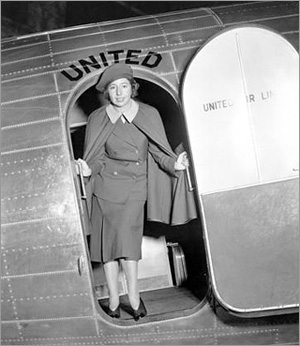
Ellen Church, 1930. (Photo credit: Upmagazine-tap.com)

Ellen Church, 1930. (Photo credit: Upmagazine-tap.com)

Yesterday, in 1930, marked the day Ellen Church made history when she became the world’s first airline stewardess to work a United Airlines flight from San Francisco to Cheyenne, Wyoming.   Her first career was as a registered nurse but Church was so thrilled by the idea of air travel that she took flight lessons.  The girl had moxie, and once she earned her wings she set her sights high by requesting a job as a pilot with Boeing Air Transport.  While that request didn’t fly, she still wanted to, so she swiftly parlayed that rejection into a savvy idea.  She offered up the suggestion to put nurses on flights to aid passengers’ fear of flying and it took off.

aeromoca-697x700

United Airlines stewardesses.

Those of us who’ve been flying the friendly skies for a while can probably recall the days when airline travel was glamorous, but it didn’t start out that way for Church and her colleagues.  Back then stewardesses were more than just nurses in the sky.  They also had to help pilots push planes into the hangar, load luggage on to the plane, fuel the aircraft and screw down seats.  Then they had to work the flight.  Physically, these women had to be attractive and less than 25 years old, weigh less than 115 pounds and stand no more than 5 feet and 4 inches tall.

southwestOver the years registered nurses transitioned to an era of sexy stewardesses, and later to the equal opportunity title of flight attendants. The cost of airline travel over the last few decades has made it more affordable for folks to fly, it’s has also changed the quality of passengers.  As the size of planes has increased and more people travel, the role of the flight attendant has changed.  The glamour of air travel is gone, tickets are loaded with surcharges, and travelers can be unruly.  Flight attendants have more than their hostessing hands full these days—they’re underpaid and stressed out, their benefits have decreased, and heightened security adds another layer of responsibility to the job.
american-flight-attendant

Like flying, we often take flight attendants for granted. Ellen Church changed the lives of women when she turned her passion for flight into a career.  It seems only right to honor her this week, and the men and women who follow in her footsteps to help get us safely from point of departure to our destination.

Whether it’s for business or pleasure, the next time you fly, take a minute to look up and acknowledge the attendants who work your flight.  Be kind. Smile. Thank them for their service. The job may seem like no big thing, but anyone who works in the customer service industry knows that’s not the case.

A little gratitude goes a long way.


Expose Yourself.

“There are always two people in every picture: the photographer and the viewer.”
-Ansel Adams

Back in the day when Kodak ruled, you’d go on vacation and eagerly await the week or two it took for your pics to develop.  Waiting built anticipation and the hope that you had some good shots—or at least one.  Digital cameras and smartphones now give us instant gratification but telling a story through photography is about more than being able to take one good shot.   Visual storytelling is your chance to make an immediate emotional connection.   Good travel photos evoke an “I wanna go!” feeling.  Like writing, one needs to adopt a “just do it” mindset in order to build your eye and style.   Much in the same way that it’s good to read from many different genres or sources, it’s good to pick your head up every once in a while and see what other photographers are doing.  Whose photographs do you connect with and what could you learn from their work that might inspire you?

(Photo credit: Andrew S.  Gibson)

(Photo credit: Andrew S. Gibson)

An article in Outside magazine about Tim Hetherington recently caught my interest.  A war photographer and filmmaker, Hetherington was killed by a mortar attack in 2011 while covering the civil war in Libya.  The article focuses on the HBO documentary, Which Way Is Front Line From HereThe Life & Time of Tim Hetherington.  The film is a tribute to Hetherington’s life and centers on why he was such a dedicated and extraordinary photojournalist   I don’t know a lot about photography, but reading about him and seeing some of his images inspired me to want to understand what made him such an incredible photographer.  If you’re more interested in telling a story through your photographs than through your words, then the life of Tim Hetherington might interest you.

English: Tim Hetherington at a photo session i...

English: Tim Hetherington at a photo session in Huambo, Angola in 2002. (Photo credit: Wikipedia)

Born and raised in England, Hetherington recognized at an early age the opportunity travel offered to connect with people during family trips.  As a young man he traveled on his own and spent two years in Tibet, China and India because he wanted to experience the lives of others.  His journeys inspired his desire to capture images and upon returning home he spent a few years studying photography and photojournalism.  He was the kind of person who made friends easily which is plus for any photographer.  He developed a keen eye and style that would later earn him awards and opportunities.  While building his professional career as a war photographer, he also used his gifts for humanitarian purposes.  He explored the use of mixed multi-media and used his abilities to shine a light in places and situations that most of us would most probably never visit.  His life is confirmation that we don’t have to live in a box and be just one thing, that we can have a multi-faceted life or career.  Travel ignited a passion for him to connect people through his lens to those less fortunate.  His compassion, insight, and professionalism, combined with his ability to capture the essence of a place and its people or a situation are the reason why he’ll forever be known for his exceptional photojournalism.

(Photo credit: Tim Hetherington)

(Photo credit: Tim Hetherington)

Untitled.  (Photo credit: Tim Hetherington)

Untitled. (Photo credit: Tim Hetherington)

Hetherington was 40 when he was killed.  He wasn’t a travel photographer but his indelible images, and life, continue to inspire and teach professionals and layman.  Sebastian Junger, who directed the HBO documentary, was a close friend of Hetherington’s and said, “Tim was trying to always think outside of the box…so he sort of made a great point of saying: ‘I don’t want to call myself a photographer.  I’m an image-maker.’ But the truth is, most of his work was still photos, and they’re beautiful. They’re stunning.”

What are you connecting to in your travels these days, whether local or afar, that inspires you to capture images and tell your stories?

You Had Me At Margaritas On The Rocks With Salt.

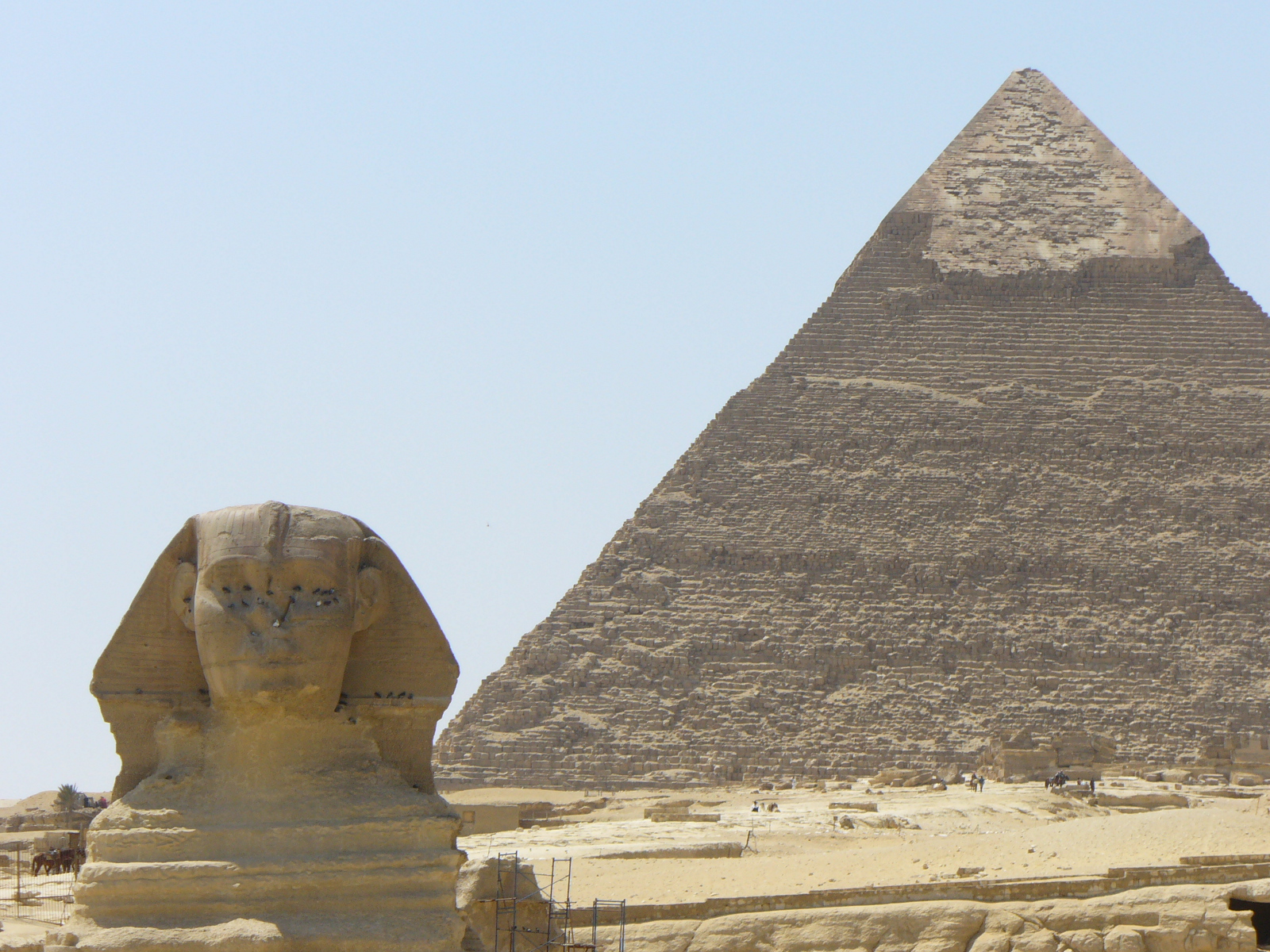
Sphinx and pyramid. (Photo by author.)

Sphinx and pyramid. (Photo by author.)

Last Saturday a friend invited me over for a Mexican dinner.  Our meal would start on the stoop with margaritas on the rocks with salt, along with fresh guacamole and chips.  Yum…she didn’t have to ask me twice!  She makes a mean margarita and a killer bowl of guac.   I could make those things myself but why should I when those are two of her specialties. I had no doubt that the main course would also be superior.  What does this have to do with writing and travel?  A few things…

So you travel agents out there…do you have specialty? If so, do you write about it?  Before creating this blog, I shared its main objective with an acquaintance that asked, “Travel agents still exist?”  “Yes, they exist,” I answered.  “Who uses them?” was his next question.  It was easy to understand his perplexity.   Most folks book their travel online, it’s where they think they’ll get the best deals.  Sometimes they do and other times they get a raw deal.  Most people use the Internet for a majority of their transactions these days.   True, it can result in huge cost savings.  It can also result in a lot of time spent in front of a computer, especially when it comes to booking travel.  They don’t call it the “web” for nothing and even if you know where you want to travel, chances are you’ll get stuck, for at least an hour but probably a lot longer, trying to figure it out.   Everything you need these days is just a click away but price doesn’t always equal value or a great experience.

Chalkley Treehouse experience at Lion Sands in South Africa. (Photo credit: Lion Sands.)

Chalkley Treehouse experience at Lion Sands in South Africa. (Photo credit: Lion Sands.)

Whether it’s eco-tourism, safaris, cruises, hiking, surfing, cooking, or whatever country you can pinpoint on the map, if there’s a destination or travel experience out there that the customer wants, as a travel agent you’re in a prime position to bring them to it.  So how do you get them to connect with you instead of spending hours at their computer looking for the best deal?  Specializing gives you an edge.  Use that edge and write about the destination or experience that you’re passionate about.  Entice them.  Show them what they’re missing and how you can bring that experience to life for them.  Writing helps readers establish a relationship with you.  It’s a way to communicate your knowledge and value up front.  It’s about building trust through your expertise.  It’s about letting them know that you’re still out there rocking in the free world of commerce.  Show them your version of a mean margarita and a killer bowl of guacamole.

Tango dancers in La Boca, Buenos Aires. (Photo by author.)

Tango dancers in La Boca, Buenos Aires. (Photo by author.)

“Two weeks ago I met a travel agent.  I thought they were all gone. Shows you how crazy I am—I’m sure there are others like me out there,” said John Walsh, CEO & President, SightSpan Inc.  He’s right—there are lots of others out there like him.  Walsh travels extensively and books online, directly with the airline.  Asked why he doesn’t use an agent he said, I don’t use a travel agent due to lack of a relationship and it seems faster for me to book business trips and vacations myself.”

Understanding this point of view needn’t be a reason for travel agents to throw in the towel, but rather an opportunity for them to understand why it’s important to leverage their expertise and assets and market themselves through writing.  Agents who specialize have a head start to differentiate themselves within the competitive marketplace to influence travelers and communicate their value.  For readers who latch on to a specialist’s insights, they won’t have to think twice about how to book their travel the next time they want to explore options about a particular destination.

Ballynahinch Castle, Galway, Ireland.  (Photo by author.)

Ballynahinch Castle, Galway, Ireland. (Photo by author.)

When I asked Walsh if he’d consider using a travel agent he said, “I would, if their services were presented with a clear value proposition and cost benefit offering.  Agents need to better state that they’re still out there and articulate their value.  They need to reeducate people of why it’s best to have a human working with you when something goes wrong—and it always does.”

Bedouin riders at Petra, Jordan. (Photo by author.)

Bedouin riders at Petra, Jordan. (Photo by author.)

The best reason for using a knowledgeable agent is that they’re there for you when the unexpected happens and you have to cancel or change your plans because an ash-cloud exploded over Europe or because you fell off your scooter in Bermuda and landed in the hospital. I hope you never have to experience having to suddenly return home from a foreign land when you booked everything on the Internet.  Any travel agent worth their salt will be able to turn you on to the best experience for your money or save you from having that “trip from hell” where perhaps your room isn’t reserved or your hotel is located in the wrong part of town.  Agents who are truly connected to a destination or travel experience can dive deep for you.  If you have any doubts, take a look at Condé Nast Traveler’s Top Travel Specialists Collection or Travel + Leisure’s A-List: Top 100 Agents and you’ll see what I mean.  After reading through a few of these specialists, you’ll be itching to escape somewhere.

So if you’re a travel agent or counselor who specializes, share your expertise.  If you’re a traveler, think about visiting your local travel agency and get to know the experts.

Margaritas on the rocks with salt. (Photo by author.)

Margaritas on the rocks with salt. (Photo by author.)

By the way, my friend’s margaritas and guacamole were excellent.  But then again, I had no doubt they would be…it’s her specialty.

Brooklyn Blossoms

Brooklyn Public Library Park Slope branch blossoms.  (Photo by author.)

Brooklyn Public Library Park Slope branch blossoms. (Photo by author.)

Any plans for a “hanami” anytime soon?  Maybe the first question should be, do you have any cherry blossom trees in your town?  If so, how about taking a walk to your local park where these trees are bursting with flowers right about now.  A “hanami” is the Japanese practice of picnicking under a blooming cherry blossom tree.  Ideally, you’d want to pack a lunch or dinner and enjoy some sake with it but there’s no need to stand on ceremony.  The point is to create a “be here now” moment and to celebrate the beauty of these trees.

I’m stuck on cherry blossoms these days.  Every year I eagerly await their arrival and go out of my to way to walk down blocks where I know they’re blooming.   Last Sunday’s New York Times travel section featured articles on walking.  Did you happen to read it?  The main feature highlighted strolls through some of Europe’s best cities: London, Tuscany, Istanbul, Madrid, Paris, Prague, Scotland, Berlin and Switzerland.  What does this have to do with cherry blossoms?  Well, after reading about these walks, it got me itching to go somewhere.  I couldn’t exactly hop a flight but I already live in a great walking city, so I put on my comfy shoes, grabbed my camera, and set out for a ramble to the Brooklyn Botanic Garden where cherry blossoms are the star attraction right now.  These trees are common throughout Brooklyn neighborhoods and while their season is spectacular, it’s short-lived so I got a move on.  With pale seashell colored blooms that burst from dark pink buds to wedding white flowers, to others that pop double-blossoms of magenta, my plan was to overdose on these beauties.

Towering cherry blossom. (Photo by author.)

Towering cherry blossom. (Photo by author.)

There are lots of tourists here today and I realize, oddly enough, that they’ve probably built this “walk” into their travel itineraries.  On weekends, people from diverse cultures arrive like lemmings to the Brooklyn Botanic Garden and in a span of 10 seconds you could easily eavesdrop on five different languages.  Young couples with their in-laws, families out to enjoy a perfect Spring day after what seemed like a never-ending winter, parents with newborns, or friends with out-of-town visitors. Wherever they’re from, everyone seems to delight in their appreciation of cherry blossoms.  This garden has 27 varieties and I’d be hard-pressed to tell you which type is my favorite.  I just take my time and soak up the good vibrations they seem to generate.  This place will really be packed this weekend when Sakura Matsuri, the Cherry Blossom Festival, celebrates traditional and contemporary Japanese culture.

Cherry blossom paparazzi at the Brooklyn Botanic Garden.  (Photo by author.)

Cherry blossom paparazzi at the Brooklyn Botanic Garden. (Photo by author.)

Cherry blossom snow drifts around a bicycle. (Photo by author.)

Cherry blossom snow drifts around a bicycle. (Photo by author.)

As much as I’d love to travel to Japan to see these trees, the inspiration to stroll in my own city has satisfied me.  On the walk back, cherry blossom petals fall like snow in the front yards of private homes and along the sidewalks.  Two trees on my block have plump pink buds just beginning to flower.  I’ll revisit the Brooklyn Botanic Garden on a weekday, when it’s more quiet, and enjoy my own hanami .  Right now, I’m quite content to appreciate their beauty from my stoop, in my own neck of the woods.  If you don’t have the time or money for a trip right now, take a stroll and see what’s blooming in your town.  Some of the most interesting and enjoyable pleasures might just be a short walk from home.  Enjoy!