Category Archives: Claudia’s Trips

Freedom To Find Happiness.

The U. S. Constitution doesn’t guarantee happiness,
only the pursuit of it. You have to catch up with it yourself.
–Benjamin Franklin

Lady Liberty from the Red Hook pier in Brooklyn.  (Photo credit: D. Powell)

Lady Liberty from the Red Hook pier in Brooklyn. (Photo credit: D. Powell)

When we think of travel, the words happiness and freedom often halo the thought.  In America, traveling for pleasure didn’t begin until after the Civil War and only the rich could do it. Anyone fortunate enough to travel these days most likely doesn’t give thought to the genesis of the idea of “vacation.”  We travel to free ourselves in some way.  Travel is escapism.  Yes, it can be all about rest and relaxation but one of the benefits of travel is that—if we allow ourselves—we break out of our own world and glimpse it through the eyes and lives of others.  We may not always like what we see but it can give us a better understanding of who we are, what we cherish, what’s important, and what matters.  A Swiss chef I once worked with told me that Americans don’t appreciate their freedoms.  This was a long time ago, and I didn’t really understand what he meant back then but over the years I get it.

This past week, at The New York Public Library on 42nd Street a rare exhibition of two of the most important American historical documents were on display together.  Anyone interested could see an original copy of the Declaration of Independence and one of the original copies of the Bill of Rights.  With the 4th of July approaching, I figured I could use a refresher on the documents that form the foundation of freedom in the United States.  As kids we learn about them in school but as we grow older we forget about them.  About what they really mean and the collaboration it took to get those ideas on paper.  We forget that pretty much everything we can do, including travel, was built on the bedrock of these ideas and the history that followed.

Let’s start with the Declaration of Independence.  It’s written in iron gall ink on handmade laid paper.  There’s hardly anything that we use that’s handmade anymore, so I was impressed just peering at it.  And I hardly know of anyone who writes by hand these days, and Thomas Jefferson’s is beautiful. The Bill of Rights displayed is one of 14 original copies.  Aside from the obvious aesthetic worth of these documents, their true value was evident by the amount of international visitors, and Americans, in the gallery. These manuscripts are slightly faded, and you have to either be really young to read them or have great eyeglasses.  But it didn’t matter.  You could hear people reciting sections from these documents and it gave me chills.  A black man who lives in Washington Heights said he wanted to see them because his family hails from South Carolina. There is slave blood in his veins and he wanted to view Jefferson’s original, unedited, version of the Declaration.  The power of these documents generated energy in that room and I felt proud.  They were giving away copies and I snatched one up.

Today is a holiday for a reason.  Before you jump on a plane or in a pool, raise the sails, or fire up the grill, kick back in a hammock or crack open a cold one, maybe take a moment to thank Adams, Franklin, Jefferson, Livingston, Sherman, and Madison, who had the intelligence, foresight and the good sense to create these documents and hook us up in a very big way.

Wherever you are, here’s to catching up with freedom and happiness.
Here’s to a Happy Independence Day!

Sweet Stuff in Toronto.

Toronto skyline.

Toronto skyline.

Visiting friends or family who live in different states or countries offers up a different perspective to experience the local scene of a place. It’s a double-trip because we can check out highlights we might be curious about and capitalize on insider info. We often take these visits for granted, they’re sometimes done out of obligation, but they can be loaded with gems. Travel agents who spend time with far-flung friends or relatives can use the opportunity to hone their writing. Interviewing their hosts, and any friends or neighbors, can expose you to a bird’s-eye view on a simple slice of life. I lived in Toronto over 20 years ago, and back then the town would roll up early. Sundays were like being in lock-down, and you couldn’t buy a thing—or a drink.  After several years, I paid a visit and surrendered my control freak nature to my sister Sandy and my brother-in-law Greg, and enjoyed a different experience of the city.  Today, Toronto pretty much operates 24/7 and the amount of construction with all the high-rise development around the waterfront area answers the question of why there’s a crane shortage. It’s crazy.

Local chill out at Sugar Beach.

Locals chill out at Sugar Beach.

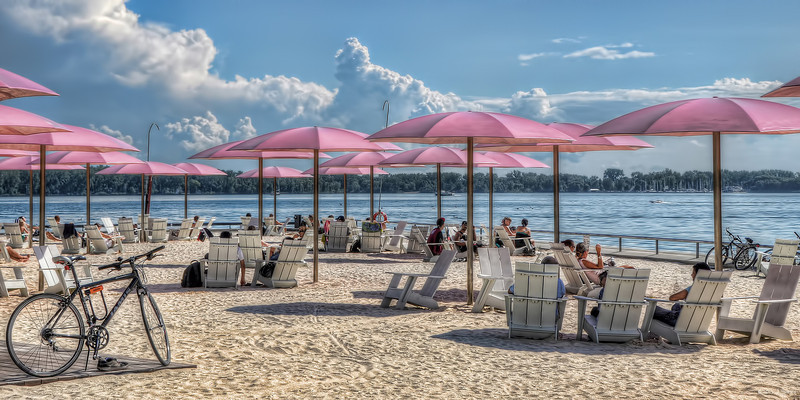
Toronto was in the grip of a heat wave, so my hosts recommended we check out Sugar Beach. This former parking lot on Queen’s Quay is now a two-acre urban beach for city dwellers. Bright bubble-gum pink umbrellas, white Adirondack style beach chairs, candy-stripe rock outcroppings, a mini boardwalk, and artificial sand offer a welcome respite for locals and tourists and a tree-lined promenade runs through the park. Our visit coincided with the Redpath Waterfront Festival, a four-day experience of nautical history, digital storytelling, extreme watersports, concerts and the Tall Ships’ 1812. Food trucks and barbecue stands catered to the crowds and reps from Tourism Prince Edward Isle offered up a cup of their famous mussels and fries if you entered their five-day getaway drawing. I submitted an entry form and quickly went from feeling like a local to a tourist but it was all good. Under a beach umbrella, we enjoyed the scene and listened to the band.  Later, we cranked up the air-conditioner and they turned me on to a sugar kiss.  A fruit that’s a cross between a cantaloupe and honeydew melon, and its sugary sweetness was pure, thirst-quenching delight. That evening we grilled black cod and sweet corn they’d picked up earlier from the famous St. Lawrence Market, where you could easily plan a day trip and experience a major food orgy.

Some major decisions are made at the St. Lawrence Market.

Some major decisions are made at the St. Lawrence Market.

A Cabbagetown house.

A Cabbagetown house.

My family lives in Cabbagetown and it’s a gem of a neighborhood. It’s the largest area of preserved Victorian houses not just in Toronto, but in North America, and strolling though it is like being in a fairyland. The Irish settled this area in the 1800s and grew loads of cabbage, hence the name. Today, it’s the picturesque architecture of the brick homes with front yards of pale peach to scarlet red rambling roses, exploding hydrangea bushes, lavender, azaleas and rhododendron that creates what feels like an exclusive haven. “I’ve never sat out here,” my sis said as we settled on her front steps, breathing in the garden’s scent and sharing intimacies on life, love and the pursuit of happiness. We typically hang out in their backyard but I guess it took this Brooklyn girl to remind her of the pleasure you get sitting on your stoop. Later, we went into the night to find the Supermoon that had graced the planet but we must have looked like zombies as we staggered through the quiet streets with our heads craned trying to glimpse it through the lush trees arches.

The next evening, we enjoyed an after dinner stroll and stopped to chat with neighbors who were enjoying their own stoop. We exchanged introductions and got talking about the city and the area. Tony grew up in Pakistan during British rule and immigrated to Toronto when he was younger. “Because of my ethnic background, things were very challenging back then,” he said. But times have changed and he and his wife Holly, from Montreal, love their life in Cabbagetown. My sister mentioned that she moved to Toronto 38 years ago from New York. “Back then it felt like a small town, and it was conservative and a bit uptight. It was mostly Scottish, English, and Irish, now there’s an amazing ethnic mix,” she said. Toronto has most definitely grown into a cosmopolitan city. The Danforth is the Greek area, there’s also a Little Italy, a Little India, Little Portugal, and Chinatown. Not to mention a dynamic food scene, shopping, music, arts and all the other ingredients that contributes to a city’s cultural vibrancy. “It’s a great city, it somewhat reminds me of New York now. And then there’s lovely Cabbagetown, which is kind of like, you know…I know the butcher, the baker and the candlestick maker,” she said. Greg’s American too, and originally came to Toronto on a research project. “I was disappointed Canada didn’t feel like a foreign country” he said. But two years later he set roots down and established himself as a professor of economics at the University of Toronto. These folks are all retired now.

Hidden lanes in Cabbagetown.

Hidden lanes in Cabbagetown.

We moved on and meandered through the neighborhood’s secret lanes, strolled through small Riverdale Park where locals walked their dogs, or just enjoyed the twilight hour on a bench. Across the park is Necropolis Cemetery, a lush and historic resting place. In front of a grand home we glimpsed feet on the top rung of a ladder that disappeared into a glorious tree whose branches spread across all directions of the garden and street. Looking up, we noticed it was a cherry tree rich with bright red drops of fruit. I asked the guy trimming it if they were edible. Then I heard a snap and he handed us a two-foot long stem, loaded with cherries. We enjoyed the sweet and juicy offering all the way home.

With the heavy heat came heavy thunderstorms. My flight was canceled and I had to spend another day with family, but it was all good.

Stay tuned for more on things to see and do in Toronto.

Field Trip.

“What is that feeling when you’re driving away from people and they recede on the plain till you see their specks dispersing? – it’s the too-huge world vaulting us, and it’s good-bye.
But we lean forward to the next crazy venture beneath the skies.”
Jack Kerouac, On the Road

Milky Way over Evans

Milky Way over Evans (Photo credit: casey mac)

Stars.  What is it about looking up into an ink black night studded with stars that makes you feel at one with the universe?  Living in New York City doesn’t give us too much opportunity to really see stars.  They’re too dimmed by the massive amount of light set to a permanent on position.  But now I was in Colorado, my aunt had died, and I was on a back porch in a small town just outside of Denver, gazing up at the heavens and the wonder of it all.  In the distance, a coyote yipped.

It’s a funny thing to travel to a place and have no agenda.  No travel agenda, that is.  There’d be no activities, no wandering.  I was there to be with my cousins, to celebrate their mother’s life. On the porch the next morning, I wanted to jump into the wide expanse of big blue sky, not a cloud in it.  Birdsong rang through the air, settled around us and came in spells from the reserve the house borders.  This breadth of land is a plain field of tall, pale grass but there’s nothing plain about it.  To the west, the Rocky Mountains were as majestic as ever.  Their snow-capped peaks shone bright in the sunlight, like massive Hershey Kisses in their foil.   This mountain range humbled me.  I’m not the first person to feel their awe.  Nature does this to us in thousands of ways, large and small.  It was going to be a heavy trip for sure, but there was something about the sweet scent of grass, and the bigness of it all that I disappeared into. The doing of…nothing, the just being, the simplicity of it all put life and death into perspective.  Made it easy to give comfort.  These mountains have been here long before us and will be here long after the last of my family has turned to dust.

Snow-Capped Colorado Rocky Mountains

Snow-Capped Colorado Rocky Mountains (Photo credit: Rockin Robin)

My aunt was born a Kansas girl but eventually set her roots and boots in Colorado.  This side of my family, and the rest of my cousins and older siblings who came to pay their respects, hail from Topeka, the Land of Oz, and when we gather it’s like a trip back in time.  We don’t see each other often but when we do there seems to come alive some semblance of a childhood preserved by the memories we share of that place and the grandparents we lost long ago.   My brood of cousins, and siblings, has the greater history of the Midwest.  They are the Kansas of my childhood visits.  They are the brilliant fields of sunflowers and tall stalks of sweet corn, and the clink-clank of the Santa Fe Railroad that chugged and whistled behind my grandparents’ faded out white house.  They are the scent of the penny candy shop that no longer exists, a barefoot walk on a hot summer’s day to the Dairy Queen, drive-in movies, and lakeside camping.   They are mid-Western mannered, speak in “yes sirs and no ma’am’s,” and have a gentility those of us who grew up on the East Coast lack.   “It smells like Topeka in here,”   I said when I entered my cousin’s Mel’s home.   “I couldn’t ask for a better compliment,” she said.  In some ways, I guess I made two trips.

Sunflowers at Sunset

Sunflowers at Sunset (Photo credit: Stuck in Customs)

Flying back, the plane had a fiery sunset on its tail all the way home and I gazed out the window until I could no longer see the fields and the Rockies.   The rest of my cousins were also flying or driving back to their homes.  We all had living to get back to but I hoped my aunt was somewhere in the springtime of her youth, running wild through a field of sunflowers.

Journey Through Time.

As kids, our parents decided where we’d go for vacations.  For many of us, that usually meant traveling by car.  If we were fortunate, we got to travel by plane and walk off with tin wings pinned to our shirt–and that made us hot stuff.  But we don’t need a visa stamp, or t-shirt, or pin to prove we’ve been some place.  Journeys aren’t defined by physical space, and in that sense travel knows no boundaries.

My brother’s ticket stub. It was Sunday night and the gig was just starting at 10PM! (Photo by author.)

This morning I woke to the news that Ray Manzarek, original founder of The Doors, had died and it took me back to my first solo trip.  It wasn’t on a plane, train or automobile.  In fact, I was lying on my bed when I heard the opening chords to Light My Fire drifting out of my older brother’s bedroom.  The sounds of Manzarek’s Vox Continental organ were dark and moody and my mind quickly welcomed them.  I hadn’t yet heard anything like it and that sound invited thoughts and feelings I’d never experienced.  My mind took off and I didn’t need a license, ticket or passport to get there.   My brother turned me on to a lot of music but my apprenticeship under him of The Doors was like an unchartered journey.  Jim Morrison might have been front and center but remove the unique sound of Manzarek and The Doors become unhinged.

Ray Manzarek (far right) and The Doors.  (Photo credit: blogsfagate.com

Ray Manzarek (far right) and The Doors. (Photo credit: blogsfagate.com)

It’s a bittersweet day for Doors’ fans but Manzarek is another great example of why it’s so important to learn and adapt to new things.  His talent, combined with those of his band mates, made if difficult to peg The Doors as just another rock band.  The man was constantly innovating, learning and experimenting.  After The Doors disbanded, he continued to play and collaborate with other bands and musicians.  Jazz, poetry, and books…the man had it going on.  The Light My Fire lyrics, “the time to hesitate is through; no time to wallow in the mire,” may have been written about passion but they easily apply to all of us, travel agents included, who suffer from any form of inertia when it comes to learning something new that might help unleash our potential.  There are no boundaries, only the ones we make for ourselves.

Ray Manzarek, 2012.  (Photo credit:  Commons.wikimedia.org)

Ray Manzarek, 2012. (Photo credit: Commons.wikimedia.org)

Once you open the doors of perception,” Manzarek said, “the doors of perception are cleansed, they stay cleansed, they stay open, and you see life as an infinite voyage of joy and adventure and strangeness and darkness and wildness and craziness and softness and beauty.”

I spent time on The Crystal Ship long before I boarded any cruise ship.  I’ll miss you Ray, thanks for the never-ending journey.

Brooklyn Blossoms

Brooklyn Public Library Park Slope branch blossoms.  (Photo by author.)

Brooklyn Public Library Park Slope branch blossoms. (Photo by author.)

Any plans for a “hanami” anytime soon?  Maybe the first question should be, do you have any cherry blossom trees in your town?  If so, how about taking a walk to your local park where these trees are bursting with flowers right about now.  A “hanami” is the Japanese practice of picnicking under a blooming cherry blossom tree.  Ideally, you’d want to pack a lunch or dinner and enjoy some sake with it but there’s no need to stand on ceremony.  The point is to create a “be here now” moment and to celebrate the beauty of these trees.

I’m stuck on cherry blossoms these days.  Every year I eagerly await their arrival and go out of my to way to walk down blocks where I know they’re blooming.   Last Sunday’s New York Times travel section featured articles on walking.  Did you happen to read it?  The main feature highlighted strolls through some of Europe’s best cities: London, Tuscany, Istanbul, Madrid, Paris, Prague, Scotland, Berlin and Switzerland.  What does this have to do with cherry blossoms?  Well, after reading about these walks, it got me itching to go somewhere.  I couldn’t exactly hop a flight but I already live in a great walking city, so I put on my comfy shoes, grabbed my camera, and set out for a ramble to the Brooklyn Botanic Garden where cherry blossoms are the star attraction right now.  These trees are common throughout Brooklyn neighborhoods and while their season is spectacular, it’s short-lived so I got a move on.  With pale seashell colored blooms that burst from dark pink buds to wedding white flowers, to others that pop double-blossoms of magenta, my plan was to overdose on these beauties.

Towering cherry blossom. (Photo by author.)

Towering cherry blossom. (Photo by author.)

There are lots of tourists here today and I realize, oddly enough, that they’ve probably built this “walk” into their travel itineraries.  On weekends, people from diverse cultures arrive like lemmings to the Brooklyn Botanic Garden and in a span of 10 seconds you could easily eavesdrop on five different languages.  Young couples with their in-laws, families out to enjoy a perfect Spring day after what seemed like a never-ending winter, parents with newborns, or friends with out-of-town visitors. Wherever they’re from, everyone seems to delight in their appreciation of cherry blossoms.  This garden has 27 varieties and I’d be hard-pressed to tell you which type is my favorite.  I just take my time and soak up the good vibrations they seem to generate.  This place will really be packed this weekend when Sakura Matsuri, the Cherry Blossom Festival, celebrates traditional and contemporary Japanese culture.

Cherry blossom paparazzi at the Brooklyn Botanic Garden.  (Photo by author.)

Cherry blossom paparazzi at the Brooklyn Botanic Garden. (Photo by author.)

Cherry blossom snow drifts around a bicycle. (Photo by author.)

Cherry blossom snow drifts around a bicycle. (Photo by author.)

As much as I’d love to travel to Japan to see these trees, the inspiration to stroll in my own city has satisfied me.  On the walk back, cherry blossom petals fall like snow in the front yards of private homes and along the sidewalks.  Two trees on my block have plump pink buds just beginning to flower.  I’ll revisit the Brooklyn Botanic Garden on a weekday, when it’s more quiet, and enjoy my own hanami .  Right now, I’m quite content to appreciate their beauty from my stoop, in my own neck of the woods.  If you don’t have the time or money for a trip right now, take a stroll and see what’s blooming in your town.  Some of the most interesting and enjoyable pleasures might just be a short walk from home.  Enjoy!

Small Town Pleasures in Nicaragua

San Juan del Sur

San Juan del Sur (Photo credit: Daniel Fajardo Valenti)

The Pacific coastline region of Nicaragua around San Juan del Sur seems to be on every list of best places to go in 2013.   Recently, I had the chance to visit and found a destination whose chill-out factor suited me just fine.  I wasn’t sure what to expect from a country listed as the second poorest in the Western hemisphere, but I was pleasantly surprised.  Nicaraguans are friendly, hospitable and mellow, and while their country may have attracted unwanted attention in the 1980s during the Iran-Contra affair, it’s now being noticed for all of the right reasons.  As one of the few places left to visit that won’t break your bank account, it’s easy to see why so many Americans and Canadians retire here.  San Juan del Sur is a tranquil fishing village that surrounds a crescent-shaped stretch of beach dotted with small bars and cafes. The town is simple to navigate and offers lots of options for eating, drinking and booking activities.  Taxis are plentiful, making it easy to check out the other lovely and uncrowded beaches up and down the coast. But if you’re looking for a bit more than soaking up the sun, here are some ideas to help plan your trip.

Five Cool Things to Do In & Around San Juan del Sur

1. Catch the Surf
Surfers helped put this area on the map and this town’s been operating as a hub for them ever since.  If you’re not ready to plant your feet on a board just yet, pitch a blanket and watch the experts.  Otherwise, no matter your age, you won’t be at a loss to find a surf camp that’ll suit you up.  Ladies, for the adventurer in you, check out CHICABRAVA—an all girls surf camp whose motto is – Get Stoked…In Style!  Founded in 2003 by 6-time Nicaraguan National surf champ, Ashley Blaylock, this retreat style camp will both challenge and pamper you.

An intermediate student gets stoked.  (Photo credit:  CHICABRAVA)

A CHICABRAVA intermediate student gets stoked. (Photo credit: CHICABRAVA)

2. Grab a Horse and Giddy-up
There are a handful of outfits around San Juan del Sur that run horseback tours for much less than what it costs to ride in the U.S.  Rancho Chilamate, an eco-friendly ranch owned and operated by an ex-pat Canadian couple, guide half-day tours at sunrise or sunset, depending on the tides.  They’ll suit and saddle you up, and include a photography tour of your ride.  In addition, a portion of the ride revenue goes back to the local community to help with healthcare and education costs, as well as other types of assistance projects.

Sunset ride on the beach.  (Photo credit:  Rancho Chilamate)

Sunset ride on the beach. (Photo credit: Rancho Chilamate)

3. Learn Spanish
If you’re looking to immerse yourself in the culture and improve your high-school Spanish, then consider adding some lessons to your itinerary. There are several language schools in and around San Juan del Sur that can easily fit into your budget, and your new skills will have you chatting with the locals in no time!

4. Grab a Mat and Get Centered
When you start your morning doing sun salutations on the beach, the day only continues to get better.  From teacher-training camps to retreats to community classes, there are several top-notch yoga schools and studios to help you “be here now.”  Several of the surf camps also offer yoga.

Bondi Beach Yoga

(Photo credit: tarotastic)

5. Get Your Munchies In the Jungle
Pizza is definitely on my desert island list of foods and as a Brooklynite, I think I can vouch for the good stuff.  Munchies Blues Cafe is a Monday night, reservation-only experience in the jungle out by Playa Marsella. They serve Roman-style pizza that rivals some of the best stuff in my own neighborhood.

This list barely scratches the surface of activities you can enjoy in Nicaragua.   Tourism is rising but there’s still time to enjoy its simple pleasures.  With a landscape made of volcanoes, jungles, lakes, lagoons, rivers, beaches and lush rainforests, this country seems to offer something for everyone.   So the next time you’re wondering where you should go, think about discovering the beauty, tranquility and people of Nicaragua.

Where There’s A Will, There’s A Way Out.

People will tell you South Africa will change your life and it will.   It’s something people told me the first time I visited.  It’s something I now tell first time visitors.  I’ve gone back twice since and each visit brings a new revelation.

As a museum and World Heritage site, Robben Island is one of those places on South Africa’s list of places to see.  I’d wanted to check it out on previous visits but for one reason or another hadn’t gotten around to it.  I’d be in Cape Town managing a conference and built in the opportunity to take a group there, so off we went.

You travel to Robben Island by ferry and you want to go when the sea is calm–which is hardly ever–so it’s best to get the first transfer of the day.  We arrived the waterfront early, boarded the boat and settled in for the thirty-minute sail across Table Bay.  A private group tour had been arranged and an eloquent and engaging gentleman from South Africa Tourism greeted us.

Robben Island tour bus. (Photo credit:  Claudia Santino)

Robben Island tour bus. (Photo credit: Claudia Santino)

He led us on to a small, white bus with the slogan “Driven By Freedom emblazoned across it.  We sat silent as our guide recounted the story behind this isolated island once used as a leper colony and hospital but whose main function, and what earned it notoriety, was as a prison camp.

You can see Cape Town from Robben Island but for the men imprisoned here it must have seemed a million miles away. The waters that surround it are rough and uninviting.  It was sunny, about 50 degrees but chilly, as the bus rolled slowly along the sandy roads through the rocky, bone-white limestone terrain.  Seagulls swooped and screeched overhead.  A clear blue sky contrasted against the brightness of the island rock and sand and there wasn’t much shade.  By all accounts it was a beautiful day for us but it wasn’t difficult to imagine the desolation felt here.  It must have been hell for the men confined to this unforgiving environment in bitter cold winds or in the high heat of the African sun.

Our guide spotted a group of jackass penguins and the bus stopped so we could snap photos of these little creatures with their donkey-like bray.  With their black-webbed feet, they waddled around the acacia shrubs like they were on their way to garden party.  For a moment it was easy to forget what this place was all about.   The protection of mammal and bird life on Robben Island contributes to its status as a World Heritage Site.  It would have been a plus to see the other wildlife but our time was limited and we were here for the cultural significance.  We were here to see the maximum, security prison that held Nelson Mandela.

About five square meters, we could only enter the cell two at a time for about a minute.  On the floor, a thin mat served as his bed.  A bucket served as the toilet.  A small, barred window offered a meager view.

Nelson Mandela's Cell

Nelson Mandela’s Cell (Photo credit: mr_mayer)

It felt strange to stand here and one by one the collective mood turned somber.  Being confined to this space had to change the way you looked at things but there was no way I could fathom what Nelson Mandela’s life was like here for one second, much less 18 years.  “My bathroom’s bigger than this,” observed one of our group members in disbelief.  Our guide recounted the dehumanization and degradation endured by Mandela and his fellow political prisoners.  We all had a general knowledge going in of what happened here, yet to learn the details while moving within these walls somehow made it different.  The bleakness of it was overwhelming.  Standing there, it was almost impossible to reconcile what happened on Robben Island with the man we’ve all come to know through the media.  With the graceful man who won the Nobel Peace Prize in 1993.  With the man who would go on to become the president of South Africa in 1994.

“Take a look to your right, that’s Robben Island University,” instructed our guide.  We saw nothing, just a pile of rocks.  But what only appeared to be a lime quarry to us was the underground college Mandela developed through limited conversations with other high-level prisoners.

Lime Quarry and memorial stones

Lime Quarry and memorial stones (Photo credit: B.T. Indrelunas)

On top of all the other hurt and humiliation, they were deprived the most basic but essential human connection—communication. Those men worked that rock in severe heat, biting wind, driving rain, and at the same time found a way to secretly discuss and engage in a discourse on free will, apartheid, their constitution and all sorts of literature.  They learned self-respect, how to practice it and how to earn it.  That this could happen said so much about the human spirit and spoke to the understanding that the cultural rules and expectations of how to navigate life and opportunity only apply if you think they do.   I recalled the saying “where there’s a will, there’s a way,” and realized the strength of that simple phrase.   It got me thinking about freedom, what is really means, what it really is and how Nelson Mandela experienced more freedom in his mind then most of us ever will.  It also got me thinking about education, the price we pay for it in the U.S., how it’s taken for granted, and how those men most likely got the true essence of its best information but at a very high cost.

Robben Island has become a return trip my mind takes every now and then.  It’s the sort of place everyone should visit.  The time and lives lost by the men imprisoned there because of apartheid can never be made right.  It’s a sobering experience but it also shows the light and spirit man can discover within himself, and others, in the hardest of circumstances and that is a beautiful thing.   The words “driven by freedom”  echo many meanings to me now.

How will South Africa change you life?  That’s something you’ll discover when you get there.    Already been?  I’d love to hear your story.